
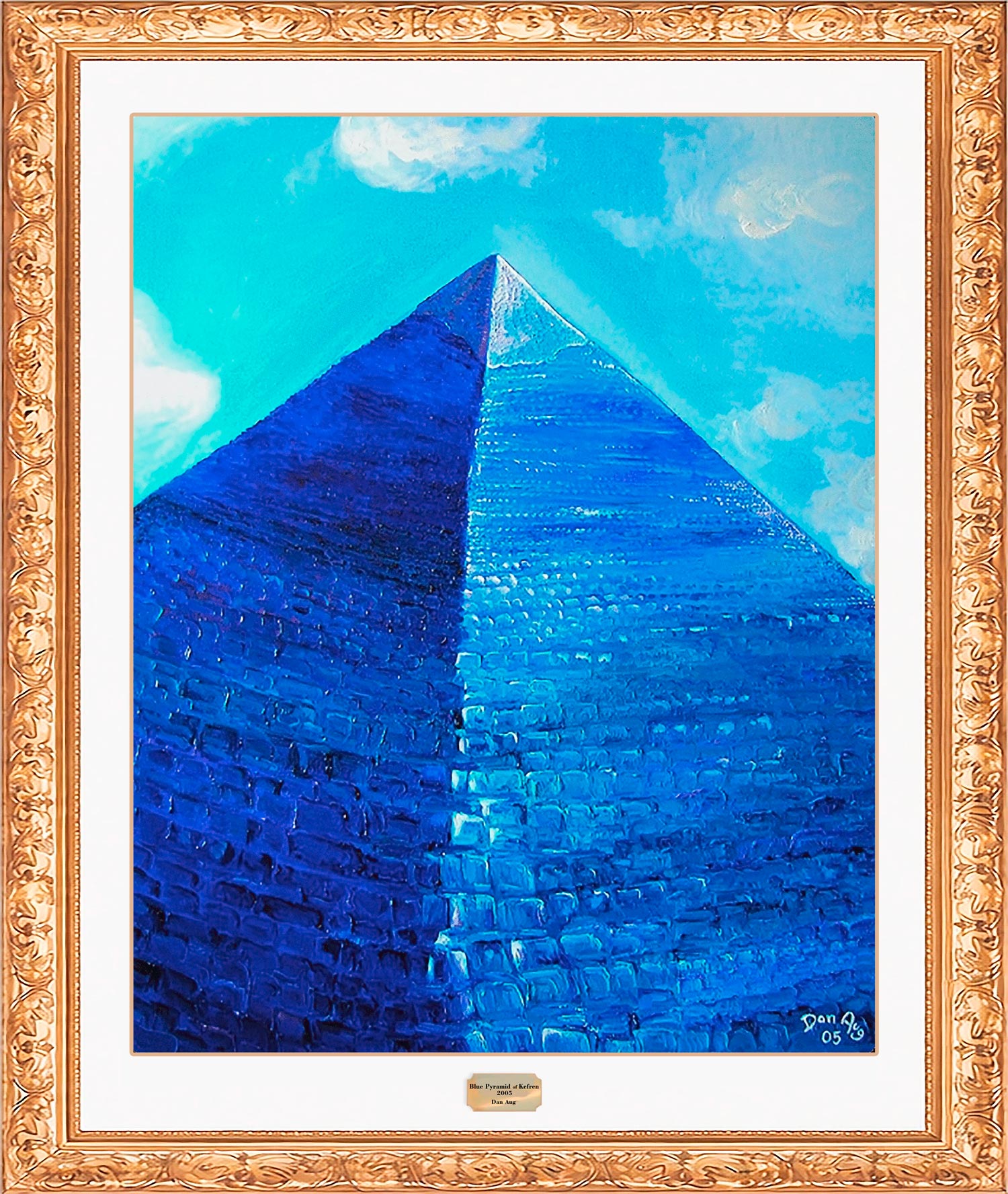
Blue Pyramid of Kefren, created in 2005, belongs to the central visual universe of Dream of a Night in Giza. The painting takes one of the most recognizable architectural forms in human history — the pyramid — and removes it from the conventions of archaeological illustration. What remains is a symbolic structure: monumental, silent, chromatically transformed and suspended between Ancient Egypt and an imagined cosmic space.
The work is not intended as a literal reconstruction of the Pyramid of Khafre at Giza. Instead, the historical monument acts as a point of departure. Through painting, color and abstraction, the pyramid becomes an object of contemplation: an ancient geometric form capable of generating contemporary questions about time, civilization, permanence, memory and humanity's relationship with the universe.
Blue Pyramid of Kefren — Artwork Record
Artist: Dan Aug (Daniel Augusto Chiesa Lanaro)Title: Blue Pyramid of Kefren
Year: 2005
Medium: Oil on canvas
Dimensions: 90 × 60 cm
Series: Dream of a Night in Giza
Selection: Core Selection
Subject: Contemporary symbolic interpretation of the Pyramid of Kefren / Khafre at Giza
Why a Blue Pyramid?
The color blue immediately separates the pyramid from the limestone reality of the Giza Plateau. This transformation is intentional. Once the expected material color disappears, the pyramid can no longer be read only as stone. It becomes an image, a sign and a psychological presence.
Blue carries a particular visual power because it can simultaneously suggest atmosphere, distance, depth and the celestial. In the context of Dream of a Night in Giza, the transformation of a monumental terrestrial structure into a blue form establishes a dialogue between earth and sky.
The pyramid remains physically recognizable, yet chromatically it begins to belong to another reality. This tension between recognition and displacement is central to the work.
Kefren, Khafre and the Giza Plateau
The title uses the form Kefren, a traditional rendering widely used in several European languages for the Fourth Dynasty Egyptian ruler generally known in English as Khafre. His pyramid is the second-largest of the three principal pyramids at Giza and remains one of the defining monuments of the plateau.
The historical monument provides the painting with a recognizable point of reference, but Blue Pyramid of Kefren does not attempt to document the architecture archaeologically. The work belongs to a contemporary artistic project in which Ancient Egypt is approached through memory, symbolism and imagination.
This distinction matters. Archaeology seeks evidence, chronology and historical understanding. Painting can operate differently. It can take a form inherited from history and ask what that form continues to provoke in contemporary consciousness.
The Pyramid as Geometry
Few architectural forms possess the immediate visual economy of a pyramid. Its geometry appears elementary, yet its presence can be overwhelming. A broad base rises toward a single point, converting mass into direction.
For an artist interested in abstraction and cosmological structures, that geometry has an obvious attraction. The pyramid can be perceived simultaneously as architecture and as pure form: triangle, axis, ascent, convergence and orientation.
In Blue Pyramid of Kefren, geometry therefore performs more than a descriptive role. The pyramid organizes the visual field and creates a structural tension between the horizontal world of the landscape and the upward direction of the monument.
Architecture and the Cosmos
One of the recurring concerns within my work is the relationship between human scale and cosmic scale. Ancient monuments can intensify that relationship because they confront us with durations far longer than an individual human life.
Standing before a pyramid — physically or imaginatively — means confronting a structure that has survived enormous historical change. Civilizations transform, languages disappear, political orders collapse and generations pass, while the geometric mass remains.
This persistence allows the pyramid to operate in the painting as an instrument for thinking about time. It belongs to history, yet its presence appears almost outside ordinary historical duration.
Giza as an Imagined Territory
Throughout Dream of a Night in Giza, Giza functions in more than one way. It is, of course, a real geographical and archaeological place. But within the paintings it also becomes an imagined territory.
This imagined Giza permits different temporal and symbolic layers to coexist. Ancient architecture can encounter abstract color. Historical references can coexist with celestial imagery. Memory can interact with speculation. The visible landscape can become an interior one.
Blue Pyramid of Kefren is particularly representative of this transformation because its subject remains unmistakable while its atmosphere moves beyond conventional representation.
From Ancient Monument to Contemporary Painting
Artists have returned to Egypt repeatedly throughout modern history, sometimes through Orientalism, sometimes through archaeology, sometimes through design and popular culture. My interest in Egypt developed differently. I was drawn toward the possibility of establishing a dialogue between ancient symbolic structures and contemporary questions.
What can a pyramid mean after thousands of years? What remains when its original cultural environment can no longer be experienced directly? How does a contemporary observer encounter a structure carrying so much accumulated historical and symbolic weight?
Painting cannot provide definitive answers to those questions. It can, however, create a space in which they remain active.
Blue Pyramid of Kefren Within Dream of a Night in Giza
Dream of a Night in Giza developed as an extended artistic exploration of Ancient Egypt, cosmology, memory, symbolism and human consciousness. Across the series, pyramids, temples, the Nile, primordial waters, celestial phenomena and symbolic figures form a visual network rather than a sequence of archaeological scenes.
Within that network, Blue Pyramid of Kefren occupies a central position because it concentrates several essential characteristics of the project into a single image: recognizable Egyptian architecture, strong geometric organization, chromatic transformation and the displacement of historical reality into visionary space.
For that reason, the painting forms part of the Core Selection of works through which the central narrative and visual identity of Dream of a Night in Giza can be approached.
The Silence of Monumental Form
There is also an element of silence in the painting. Monumental architecture does not speak, yet it produces questions. The pyramid does not explain itself to the contemporary observer. Its physical presence is immediate while much of the civilization that produced it can only be reconstructed through surviving evidence.
Painting allows that silence to remain productive. Instead of filling every uncertainty with narrative, the image can preserve ambiguity. The blue pyramid can remain simultaneously monument, geometry, memory and imagined cosmic object.
The Artist's Voice
The short video below records my own commentary on Blue Pyramid of Kefren. It provides a direct artist's perspective on the work and complements the official artwork record and this curatorial essay.
The video is deliberately concise. Its purpose is not to establish a definitive interpretation but to preserve another layer of documentation: the artist speaking directly about a work created within the evolving universe of Dream of a Night in Giza.