
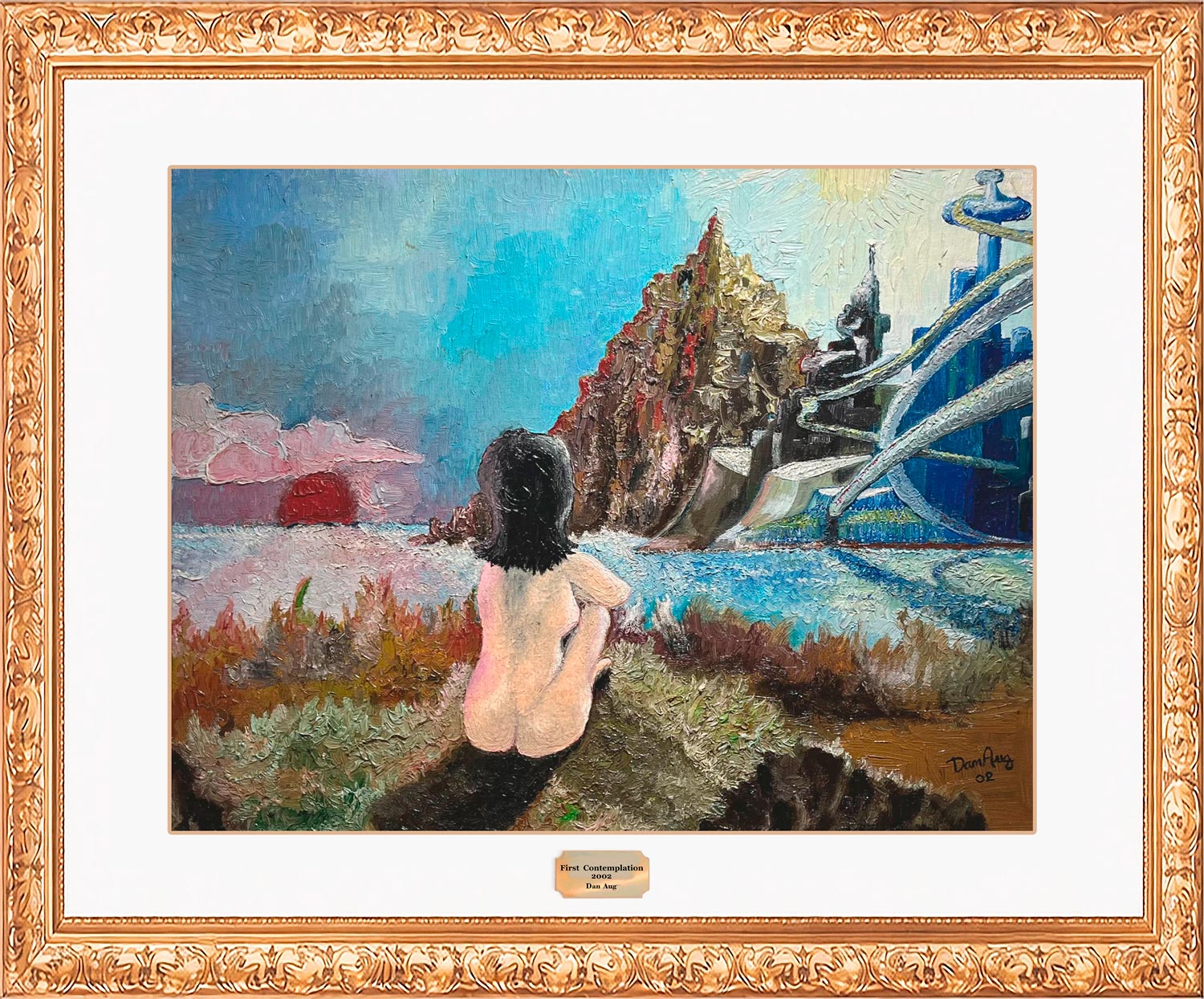
First Contemplation occupies a particular place in the development of Dream of a Night in Giza. Created in 2002, the small oil painting on canvas board contains several visual ideas that would later expand into a much broader body of work: an imagined Egyptian landscape, a meditative human presence, celestial duality, primordial forms and the sensation that the visible world may be only one layer of a larger reality.
Rather than functioning as an archaeological reconstruction of Ancient Egypt, the painting emerged from a personal and symbolic approach. Egypt became, for me, not simply a historical location but a field of contemplation — a meeting point between memory, cosmology, myth, architecture and the enduring human impulse to look beyond immediate appearances.
First Contemplation — Artwork Record
Artist: Dan Aug (Daniel Augusto Chiesa Lanaro)Title: First Contemplation
Year: 2002
Medium: Oil on canvas board
Dimensions: 40 × 50 cm
Series: Dream of a Night in Giza
Context: Foundational work in the development of the series
A Beginning Rather Than an Illustration
When I look at First Contemplation today, its importance is not based on scale or technical complexity. Its significance lies in what began to appear within it. Elements that were initially intuitive started to establish relationships with one another and eventually became part of the symbolic vocabulary of Dream of a Night in Giza.
The painting therefore works less as an illustration of a predetermined story than as an opening. It marks a point at which Egyptian references, cosmic imagery and interior contemplation began to converge inside the same pictorial space.
This distinction is essential to understanding the series. My intention was never to reproduce Ancient Egypt as an academic reconstruction. Historical Egypt remains an extraordinary civilization with its own archaeological, religious and cultural realities. The Egypt of these paintings belongs instead to artistic imagination: it is an interpretive territory constructed through color, geometry, memory and symbolic association.
The Twin Suns
Among the most immediately recognizable elements in First Contemplation are the two solar forms. The presence of twin suns creates a deliberate displacement from ordinary reality. A familiar landscape becomes impossible, or at least uncertain.
Within the painting, the doubled solar image can be read as a visual threshold: between the physical and the imagined, the historical and the timeless, observation and inner vision. The two suns do not need to describe a literal astronomical system. Their function is poetic and symbolic. They announce that the world represented in the painting follows a different order.
This idea of celestial duality would become compatible with a broader interest running through my work: the relationship between human consciousness and the universe. Astronomy, cosmology and painting approach that relationship from radically different disciplines, yet all of them begin with the act of looking.
The Benben and the Idea of Emergence
Another central reference is the Benben, the primordial mound associated with ancient Egyptian cosmogonic traditions. Within those traditions, the image of a first mound emerging from primordial waters became a powerful expression of origin, manifestation and the beginning of an ordered world.
In First Contemplation, I approach that idea through visual metaphor rather than archaeological description. The primordial form becomes part of an imagined landscape in which creation is not presented as a remote event but as a continuing possibility — something that can be contemplated again through art.
Egypt as a Contemporary Visual Territory
Ancient Egyptian imagery has been interpreted repeatedly across centuries and cultures. In contemporary art, however, the challenge is not merely to reuse recognizable symbols. The more interesting question is whether those symbols can participate in a new visual language without pretending to replace their historical meanings.
In the development of Dream of a Night in Giza, pyramidal structures, temples, solar forms, the Nile, primordial waters and symbolic figures gradually became components of a personal pictorial vocabulary. They operate simultaneously as references to Egypt and as structures through which broader questions of time, consciousness, civilization and cosmology can be considered.
First Contemplation stands close to the beginning of that process. Its landscape already exists somewhere between the terrestrial and the imagined. It is recognizably connected with Egypt, yet it does not claim to represent a specific archaeological site or historical episode.
From First Contemplation to Dream of a Night in Giza
What began as an individual painting eventually developed into a larger artistic cycle. Across the subsequent works of Dream of a Night in Giza, recurring forms and ideas began to establish connections: the Nile as both physical river and symbolic passage, temples as thresholds, pyramidal geometry, celestial phenomena, primordial waters and figures inhabiting an uncertain boundary between memory and imagination.
The series expanded through painting, writing and an increasingly developed internal mythology. Within that wider universe, Neferu became a central symbolic presence, connecting visual experience with themes of memory, transcendence and the imagined dialogue between ancient and contemporary worlds.
Seen retrospectively, First Contemplation can therefore be understood as one of the points from which this larger constellation developed. It does not contain every later element of the project, but it contains the impulse that made those later developments possible.
Contemplation as an Artistic Method
The word “contemplation” in the title is important. Painting can be an act of construction, but it can also be an act of sustained attention. To contemplate is not simply to observe an object. It is to remain with an image, question or experience long enough for additional meanings to emerge.
That attitude connects the human figure, the landscape and the celestial forms in this work. The viewer is invited not to decode a single fixed message, but to enter a state of visual questioning. The painting offers symbols, but it does not close their interpretation.
The Artist's Voice
More than two decades after the painting was created, I can speak about First Contemplation with the perspective provided by the works that followed it. Some meanings become clearer only retrospectively. An early painting can contain intuitions whose importance becomes apparent only after an entire series has developed around them.
The video below records my own commentary on the work and provides a direct complement to this essay. The painting remains the primary object; the commentary documents how I understand its place within the larger evolution of Dream of a Night in Giza.