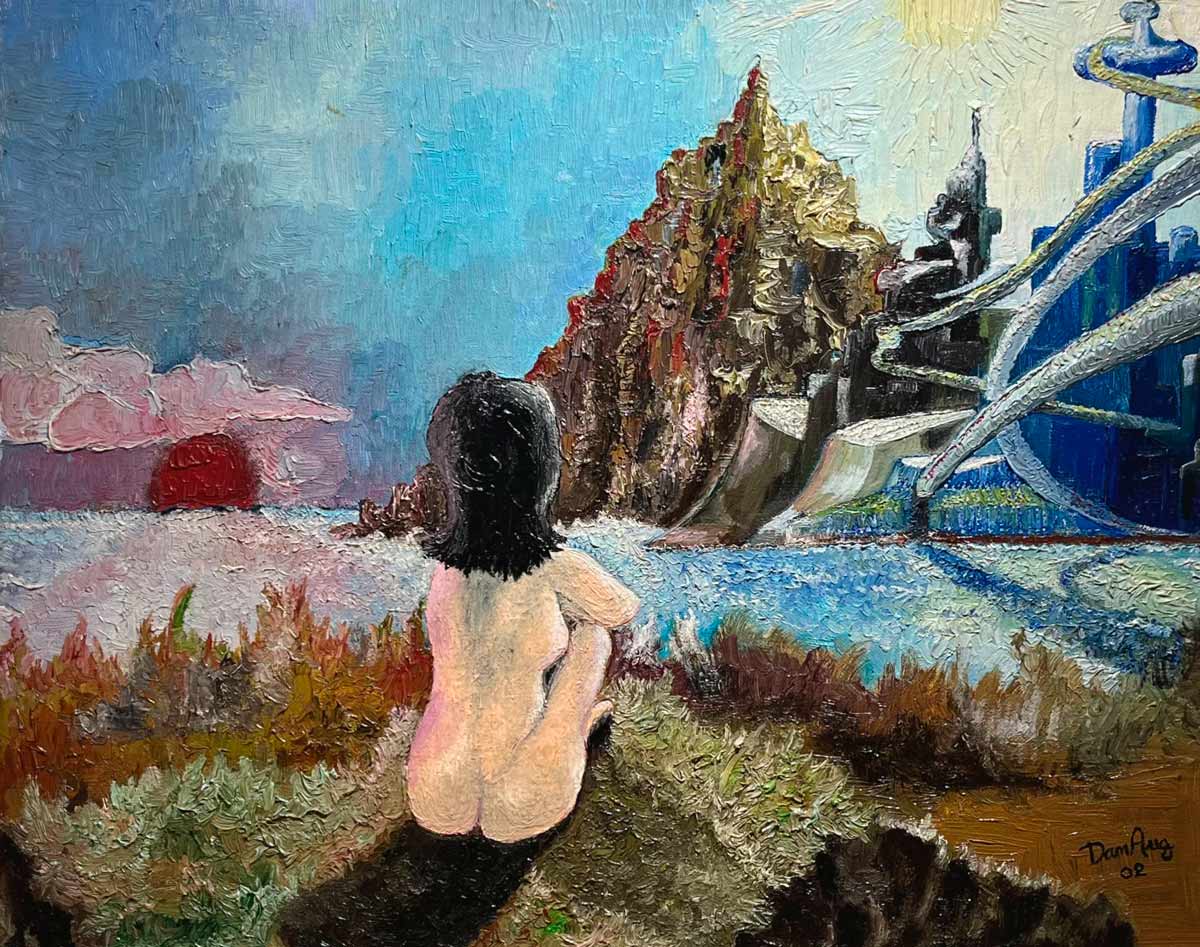
Dream of a Night in Giza was never conceived as a conventional illustration of Ancient Egypt. What began in 2002 as an intuitive encounter between painting, memory and symbolic imagination gradually expanded into a cycle of 46 original paintings: an extended visual investigation of Egypt, cosmology, architecture, myth and the human fascination with civilizations that appear to speak across time.
The series developed over more than two decades. Its imagery moves between Giza, Saqqara, the Nile, temples, pyramids, primordial waters and imagined cosmic landscapes. Yet the purpose of the project has never been archaeological reconstruction. Ancient Egypt functions instead as a territory through which questions of memory, consciousness, time and transcendence can be explored through contemporary painting.
The Beginning: First Contemplation, 2002
The conceptual origin of the cycle can be traced to First Contemplation (2002). The painting established several ideas that would subsequently return throughout the series: an Egyptian landscape transformed by imagination, the presence of celestial phenomena, symbolic architecture and a visual world situated somewhere between material reality and inner experience.
In retrospect, First Contemplation became more than the first painting chronologically. It established the possibility that a single image could open into a much larger universe.
Why Forty-Six Paintings?
The number forty-six was not established in advance as a conceptual formula. The cycle expanded organically as individual works began to form relationships with one another. Certain paintings investigated monuments and architecture; others approached the Nile, celestial phenomena, mythology, ritual space, primordial landscapes or the imagined spiritual dimension of Ancient Egypt.
Gradually, the paintings ceased to function only as independent objects. Together they formed a visual vocabulary. Pyramids, horizons, twin suns, water, passages, temples, geometries and recurring figures began to operate as interconnected elements within a broader artistic structure.
This transformation from individual paintings into a sustained cycle is central to understanding Dream of a Night in Giza. Its forty-six works should not be read as forty-six illustrations of Egypt, but as forty-six points of entry into a single evolving pictorial universe.
Ancient Egypt Without Archaeological Reconstruction
Ancient Egypt has generated an enormous visual tradition in Western culture, from nineteenth-century Orientalism to cinema, archaeological illustration and popular fantasy. Dream of a Night in Giza deliberately follows a different path.
The paintings do not attempt to reproduce the ancient world with historical precision. Instead, Egypt is filtered through contemporary visual language: abstraction, geometry, chromatic fields, symbolic architecture, material textures, iridescent surfaces and imagined celestial phenomena.
The result occupies a territory between the recognizable and the invented. A pyramid can remain unmistakably a pyramid while simultaneously becoming a geometric, cosmological or psychological form.
Giza as a Symbolic Territory
Within the series, Giza is more than a geographical location. The pyramids operate as structures situated at the intersection of earth, sky, civilization and deep time.
This idea becomes particularly visible in Blue Pyramid of Kefren, where the familiar monument is removed from conventional archaeological color and reconstructed through an immersive spectrum of blue.
The transformation is intentional. The pyramid is no longer merely an ancient structure seen from outside; it becomes an object of contemplation, memory and imaginative projection.
Saqqara, Imhotep and the Material Presence of Egypt
The relationship between physical place and artistic imagination becomes especially direct in Wonders of Saqqara (2019).
Created following direct experience of the archaeological landscape of Saqqara, the work incorporates real sand collected at the site. The material is embedded into the painting itself, creating a physical continuity between the contemporary artwork and the place that inspired it.
The painting also reflects on the architectural legacy of Imhotep and the Step Pyramid of Djoser, one of the decisive moments in the development of monumental stone architecture.
In this instance, representation becomes material presence: the painting does not simply refer to Saqqara — a fragment of Saqqara exists within it.
From Landscape to Cosmology
As the series expanded, its Egyptian landscape increasingly opened toward cosmological questions. Suns, stars, horizons, primordial waters and celestial geometries became recurring elements.
This development reflects one of the fundamental tensions within Dream of a Night in Giza: the relationship between human civilization and the universe surrounding it.
The monumental architecture of Ancient Egypt provides an extraordinary visual language for that dialogue. Pyramids rise from the desert toward the sky. Temples organize light, procession and orientation. The Nile introduces cycles of water, fertility and renewal. Myth transforms celestial and natural phenomena into narrative.
The paintings reinterpret these relationships through the sensibility of contemporary art rather than attempting to reproduce ancient belief systems.
Neferu and the Emergence of a Narrative Universe
A further transformation occurred when the visual universe of the paintings began to intersect with the fictional world of Neferu.
Neferu gradually became a symbolic presence connecting memory, transcendence and the imagined dialogue between ancient and contemporary worlds. Together with Thal-Ra and other narrative elements, the character extended the project beyond painting into literature and philosophical fiction.
This relationship eventually became associated with The Legacy of Neferu, creating a bridge between the pictorial cycle and a larger narrative universe.
The connection is important because it reveals that Dream of a Night in Giza is not simply a collection organized around a historical subject. Over time, it developed its own internal mythology.
From 46 Paintings to a Core Selection
Although the complete cycle contains forty-six original paintings, a Core Selection of 18 works has been established to present the principal conceptual and visual structure of the project.
The Core Selection does not replace the complete cycle. It functions as a curatorial gateway: a concentrated group of paintings through which the evolution of the series can be understood by collectors, curators, institutions and new audiences.
Explore the Core Selection
Discover the curated group of 18 paintings representing the central visual and conceptual architecture of Dream of a Night in Giza.
View the 18 Core Works Explore the SeriesThree Works, Three Moments in the Cycle
Selected Works
- First Contemplation (2002) — the foundational work from which the visual universe began to emerge.
- Blue Pyramid of Kefren (2005) — a transformation of monumental architecture into chromatic and symbolic experience.
- Wonders of Saqqara (2019) — a late-period mixed-media work incorporating real sand collected at Saqqara.
A Project Developed Across More Than Two Decades
The distance between First Contemplation in 2002 and Wonders of Saqqara in 2019 demonstrates the extended chronology behind the project. The cycle was not produced as a short thematic exercise. It developed through years of painting, reading, travel, reflection and continued engagement with Ancient Egypt and cosmological thought.
That duration is visible in the differences between the works. Techniques change. Color changes. Materials change. Some paintings are strongly architectural; others are almost metaphysical. Some remain close to recognizable Egyptian imagery, while others move toward abstraction.
What maintains their unity is not a single style but a persistent question: why does Ancient Egypt continue to exercise such extraordinary power over contemporary imagination?
The Complete Cycle
Today, Dream of a Night in Giza comprises 46 original paintings developed as an extended contemporary artistic meditation on Ancient Egypt, Kemet, Giza, Saqqara, mythology, cosmology, architecture, memory and human imagination.
Seen individually, the paintings are independent works. Seen together, they reveal something different: a visual narrative constructed across time, in which places, symbols and imagined characters repeatedly return and acquire new meanings.
Perhaps this is why the project became forty-six paintings rather than remaining a handful of Egyptian-inspired works. The subject never truly closed. Each painting created the possibility of another.