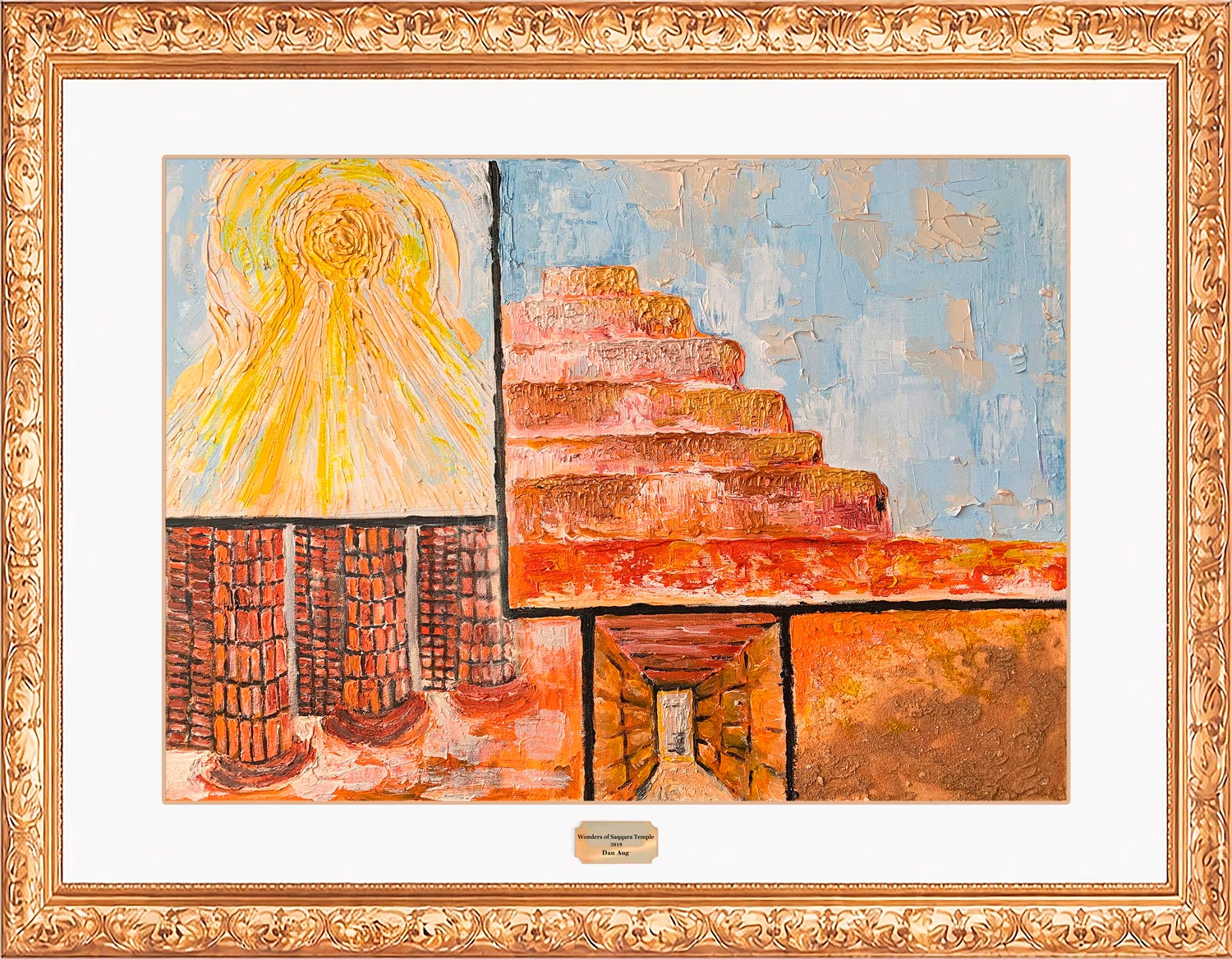
Wonders of Saqqara is a 2019 mixed-media painting by Uruguayan–Italian visual artist Dan Aug (Daniel Augusto Chiesa Lanaro), created as part of his long-term Egyptian visionary painting cycle Dream of a Night in Giza. The work emerged from the artist's direct encounter with Saqqara, one of the most historically significant archaeological landscapes of ancient Egypt.
Within the series, Wonders of Saqqara occupies a distinctive position. Rather than approaching the ancient landscape solely through representation, the painting physically incorporates a material element from the place itself: real sand collected at Saqqara.
Saqqara: Where Monumental Architecture Changed History
Saqqara occupies an exceptional place in the architectural history of ancient Egypt. Its monumental landscape is inseparable from the Step Pyramid of Djoser, traditionally associated with the extraordinary architectural vision of Imhotep.
The Step Pyramid complex represents one of the decisive transformations in the history of monumental construction: the development of architectural forms in stone on a scale that would profoundly influence the evolution of Egyptian sacred and funerary architecture.
For Dan Aug, however, Saqqara is not treated merely as an archaeological subject. Its structures become part of a visual meditation on memory, architecture, material, time and continuity.
From Saqqara to the Studio — Field Research in Egypt
The origins of Wonders of Saqqara are inseparable from Dan Aug's direct experience of the archaeological site. During his time at Saqqara, the artist studied the extraordinary relationship between desert, stone, architecture, light and space surrounding the Step Pyramid complex.
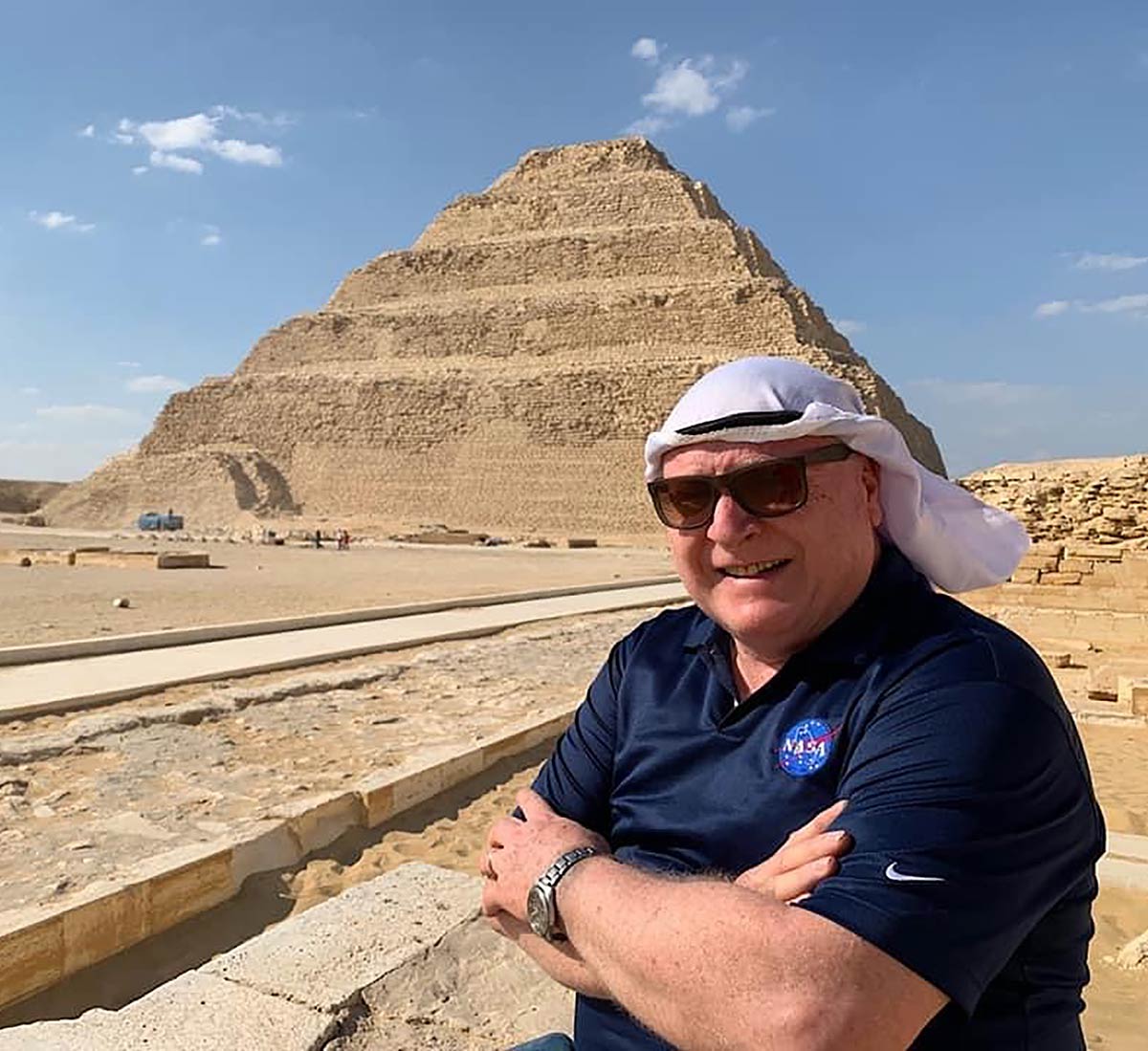
This encounter was more than a visual reference. Moving through the site allowed the artist to experience directly the scale and spatial rhythm of the complex: its ceremonial passages, stone walls, architectural sequences, columns, textures and the constantly changing relationship between constructed space and the surrounding desert.
Wonders of Saqqara emerged as a tribute to this on-site investigation — an attempt to translate the physical experience of Saqqara and the architectural legacy of Imhotep into the material language of contemporary painting.
The Material Presence of Saqqara
The defining physical characteristic of Wonders of Saqqara is the incorporation of authentic sand collected by the artist during his visit to the archaeological site.
Embedded into the work, this material establishes a direct physical relationship between the contemporary painting and the landscape that inspired it.
This gesture changes the conceptual status of the work. The sand is not simply decorative texture. It functions as material memory: a tangible connection between the archaeological landscape of Egypt and the contemporary surface of the painting.
Representation and physical presence therefore coexist. The artwork simultaneously evokes Saqqara and incorporates matter originating from Saqqara itself.
Djoser and the Legacy of Imhotep
At the conceptual center of the composition lies the architectural universe associated with Djoser and Imhotep.
The painting recalls the extraordinary vocabulary of the Step Pyramid complex: ceremonial passageways, rhythmic architectural structures, columns, walls and spatial sequences that transform movement through architecture into a symbolic experience.
Rather than reproducing these elements archaeologically, Dan Aug reinterprets them through the visual language developed throughout Dream of a Night in Giza.
Geometry, texture, color and symbolic architecture become mechanisms through which the ancient site is reconstructed as memory rather than documentation.
An Earlier Meditation: Imhotep Masterpiece (2004)
The architectural legacy of Imhotep had already entered Dan Aug's visual vocabulary years before Wonders of Saqqara. In Imhotep Masterpiece (2004), the artist centered the composition on the stepped form of Djoser's pyramid, framed by an imagined architectural environment of columns, stone structures and desert.
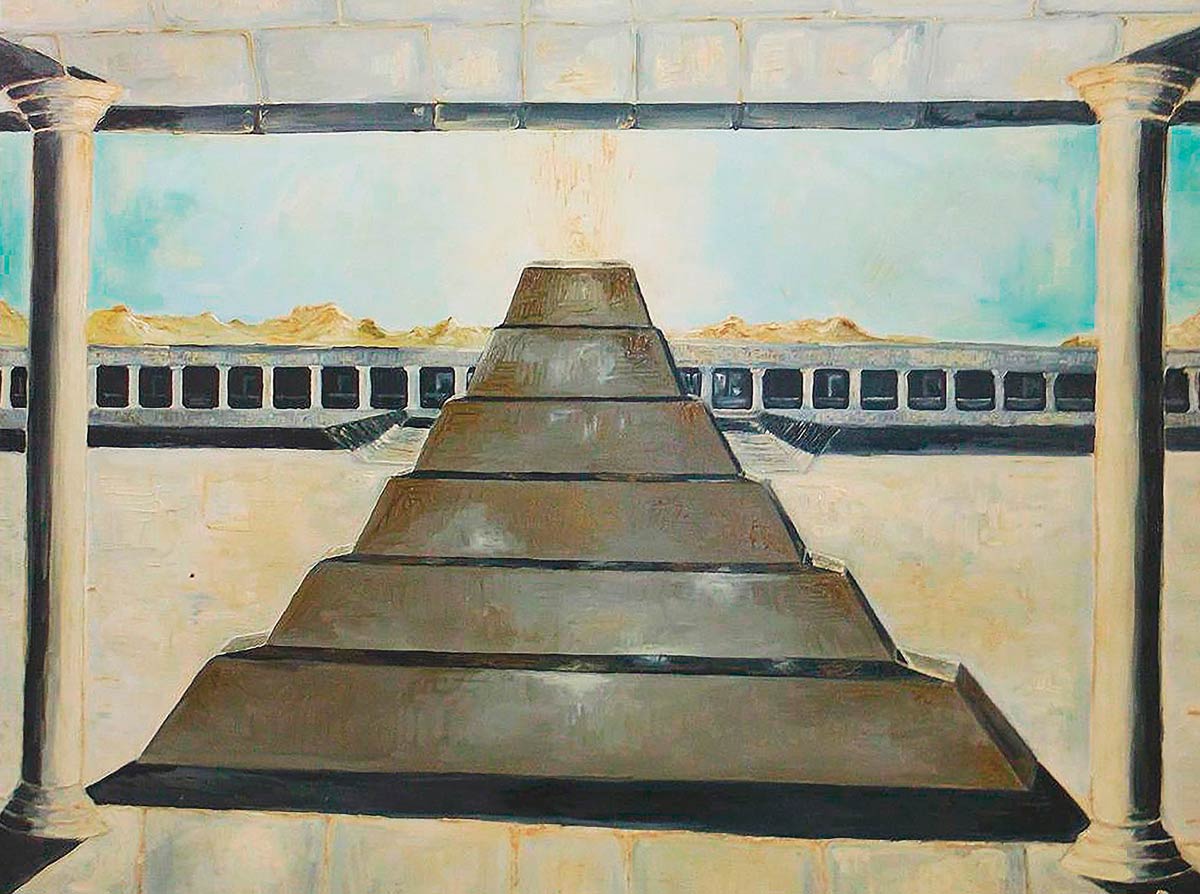
Seen alongside Wonders of Saqqara, the 2004 painting reveals the persistence of Saqqara and Imhotep within the artist's Egyptian imagery. The two works are separated by fifteen years, yet they form part of the same sustained investigation into architecture, memory and the symbolic presence of ancient Egypt.
Where Imhotep Masterpiece approaches Saqqara through painting and imagined architectural reconstruction, Wonders of Saqqara later extends that dialogue into the physical material of the archaeological landscape itself.
From Archaeological Landscape to Contemporary Painting
Throughout Dream of a Night in Giza, ancient Egypt functions not as a historical backdrop but as a conceptual territory.
Pyramids, temples, the Nile, celestial phenomena and sacred architectural forms repeatedly appear throughout the cycle, transformed through abstraction, symbolic geometry and imaginative interpretation.
In Wonders of Saqqara, this approach becomes particularly physical. The boundary between image and place is partially dissolved through the presence of actual geological material.
The work therefore exists at an intersection between painting, mixed media, archaeological memory and contemporary symbolic art.
Wonders of Saqqara within Dream of a Night in Giza
Created in 2019, Wonders of Saqqara belongs to the later period of Dream of a Night in Giza, a cycle comprising 46 original paintings developed by Dan Aug through more than two decades of artistic research and experimentation.
The series explores Ancient Egypt and Kemet through a contemporary visual language in which archaeology, mythology, cosmology, architecture and personal memory continuously intersect.
Within this broader body of work, Wonders of Saqqara represents one of the clearest examples of the artist's attempt to connect the physical world of Egypt with the symbolic universe of the paintings.
Its significance comes not only from what it depicts, but from what it materially carries.