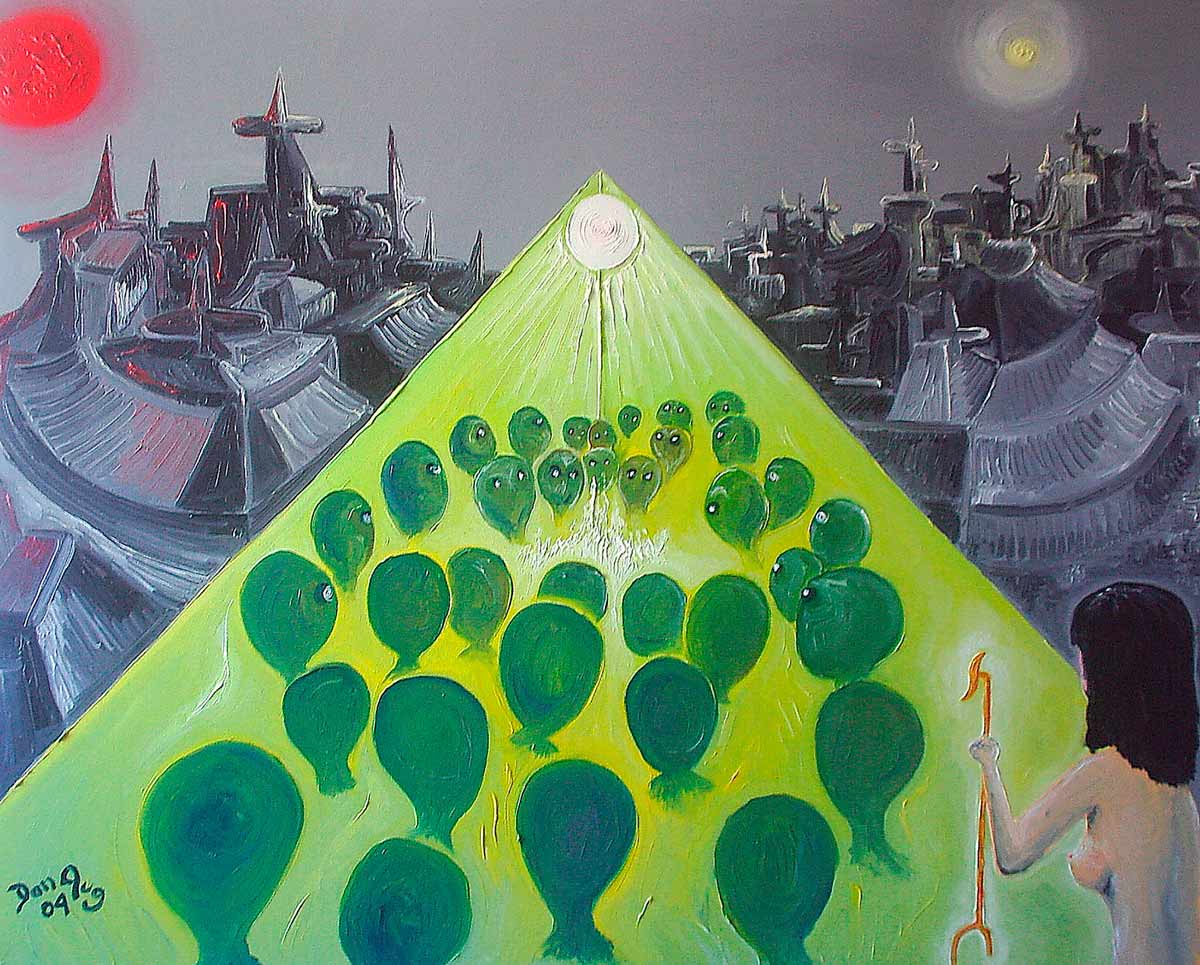
At first sight, Dream of a Night in Giza appears to be a cycle about Ancient Egypt: pyramids, temples, desert landscapes, the Nile, celestial phenomena and the monumental architecture of a civilization whose presence continues to resonate thousands of years after its creation.
But beneath that visible world another narrative gradually emerged. Across the paintings, symbols and literary development of the project, two names acquired particular significance: Neferu and Thal-Ra.
They belong to a space where painting and fiction intersect — a symbolic territory connecting Ancient Egypt, memory, cosmology, human consciousness and the possibility of dialogue across time.
Who Is Neferu?
Within the creative universe developed by Dan Aug, Neferu is more than a conventional fictional character.
She operates as a symbolic presence: a bridge between worlds, between memory and imagination, and between the historical fascination of Ancient Egypt and a contemporary meditation on existence.
Her presence became increasingly important as the visual language of Dream of a Night in Giza expanded beyond individual paintings.
Egyptian landscapes could suggest memories. Architecture could become a threshold. Celestial phenomena could imply connections extending far beyond the archaeological world.
Neferu inhabits this territory.
Thal-Ra: The Other Presence
Alongside Neferu emerges Thal-Ra, another essential presence within the narrative universe associated with the project.
The relationship between Neferu and Thal-Ra expands the conceptual space surrounding the paintings. Their story introduces a human and emotional dimension into a visual world otherwise dominated by monumental architecture, celestial space and symbolic landscapes.
Through them, the project begins to move between two scales: the immense scale of civilization and cosmology, and the intimate scale of individual consciousness.
This tension — between the cosmic and the personal — became one of the recurring structures behind both the paintings and the literary world that subsequently developed around them.
The Hidden Narrative Behind Dream of a Night in Giza
The complete Dream of a Night in Giza cycle comprises 46 original paintings developed across more than two decades.
Not every painting contains Neferu or Thal-Ra literally. Nor should the series be interpreted as a sequence of illustrations for a novel.
The relationship is more subtle.
The paintings and the literary narrative grew within a shared conceptual environment. Certain symbols, landscapes and questions move between them: pyramids, horizons, light, passages, celestial phenomena, memory, time and the mysterious persistence of the past.
The result is an artistic universe in which painting can suggest a narrative without describing it explicitly.
Painting Before Story
An important element in understanding the project is that its visual world was not simply created to illustrate a pre-existing literary story.
The paintings possess their own chronology and artistic autonomy. The foundational work, First Contemplation (2002), already established an imagined Egyptian landscape in which celestial and symbolic elements coexist.
As further works appeared, relationships began to emerge between architecture, landscape, light and recurring symbolic forms.
In this sense, the paintings helped create the territory from which the narrative could grow.
Ancient Egypt as Memory Rather Than Reconstruction
Neither the paintings nor the world of Neferu attempt to reconstruct Ancient Egypt archaeologically.
Historical Egypt remains fundamental to the project, but it functions as the point of departure for another investigation.
What happens when a civilization survives not only through monuments and archaeological evidence, but through the imagination of people living thousands of years later?
What happens when Giza, Saqqara, the Nile or an Egyptian temple become internal landscapes as much as physical places?
These questions are central to the artistic logic of Dream of a Night in Giza and to the emergence of Neferu.
Architecture as Threshold
Architecture repeatedly functions as more than background within the series.
The pyramid, temple, passageway and ceremonial structure can become thresholds between different states of perception.
In Blue Pyramid of Kefren, for example, monumental architecture is transformed through color. The pyramid remains recognizable, yet its blue chromatic environment moves it away from archaeological realism and toward contemplation.
Likewise, Saqqara becomes both physical and symbolic territory in Wonders of Saqqara, where real sand collected at the archaeological site enters the material structure of the painting itself.
These transformations are important to the narrative world because they establish a recurring idea: a place may exist simultaneously as geography, memory and symbol.
Neferu Between Past and Future
Neferu occupies precisely this ambiguous territory.
She is associated with Ancient Egypt, yet her meaning is not confined to the ancient world. Her symbolic function reaches toward questions that remain contemporary: identity, consciousness, love, mortality, memory and humanity's place within a universe vastly older than civilization itself.
This temporal ambiguity allows the character to connect worlds that would otherwise remain separate.
Past and future.
Archaeology and imagination.
Human intimacy and cosmic scale.
Painting and literature.
From Neferu to The Legacy of Neferu
The narrative dimension eventually expanded into The Legacy of Neferu, the literary work associated with this broader creative universe.
The book develops ideas that painting can only suggest differently. Characters can speak. Relationships can unfold through time. Philosophical and cosmological questions can become part of a narrative structure.
Yet the connection with the paintings remains fundamental.
Both emerge from the same persistent fascination: the possibility that Ancient Egypt can function not merely as an object of historical study, but as a powerful imaginative framework through which contemporary questions can be explored.
Explore The Legacy of Neferu
Discover the literary dimension of Neferu and its connection with the artistic and philosophical universe developed by Dan Aug.
The Legacy of Neferu Neferu in Dream of a Night in GizaTwo Universes That Became One
The relationship between Dream of a Night in Giza and The Legacy of Neferu is therefore not simply a relationship between paintings and a book.
They are different expressions of a shared imaginative universe.
Painting communicates through color, material, scale, geometry and visual silence. Literature operates through language, character, time and narrative.
Where one medium reaches its limit, the other can continue.
Neferu and Thal-Ra occupy the space between them.
Why the Narrative Remains Partly Hidden
The narrative behind the paintings was never intended to explain every image.
Explanation can sometimes diminish visual art. A painting that is reduced to a single story loses part of its capacity to remain open to interpretation.
For that reason, the narrative dimension of Dream of a Night in Giza operates beneath the surface.
A viewer does not need to know Neferu or Thal-Ra to experience the paintings.
But once their existence is known, certain relationships can become visible: recurring landscapes, thresholds, figures, celestial references and the persistent sensation that the Egyptian world represented in the series belongs to a larger story.
Neferu as a Symbol of Continuity
Perhaps the most important role of Neferu is continuity.
Ancient Egypt itself is a civilization defined, in part, by an extraordinary relationship with continuity: continuity between life and death, between generations, between earthly order and cosmic order, between monument and memory.
Within Dan Aug's contemporary artistic universe, Neferu reinterprets that idea.
She becomes a symbolic link between what has disappeared and what continues to exist through memory, imagination and art.
This is also why her presence extends beyond any single painting or literary episode.
The Narrative Inside the 46 Paintings
Seen from this perspective, the forty-six works of Dream of a Night in Giza acquire another possible reading.
They can be viewed individually as contemporary paintings inspired by Ancient Egypt.
They can be viewed collectively as an extended visual investigation of Giza, Saqqara, Kemet, architecture, cosmology and symbolism.
And they can also be approached as fragments of an imagined universe within which Neferu and Thal-Ra exist.
These readings do not contradict one another.
They overlap.
Beyond the Paintings
Dream of a Night in Giza began with painting, but its development revealed that the imaginative territory behind the works was larger than a single medium.
Neferu and Thal-Ra became part of that expansion.
Their presence does not transform the paintings into illustrations. Instead, it reveals another layer within the project — one in which art, literature, Ancient Egypt and cosmological imagination intersect.
The monuments remain.
The desert remains.
The stars remain.
But behind them exists another story.
Dream of a Night in Giza
Explore the Core Selection of 18 works from the complete 46-painting cycle and discover the visual universe in which the story of Neferu emerged.
Explore the Core Selection Discover Dream of a Night in Giza